History Of Marwood Parish
Marwood Parish boasts a rich history, evolving from a small rural community into a vibrant area.
A short history
Marwood village is mentioned in the Life of St. Cuthbert, written in 1050 AD, which indicates Marwood's existence in 990 AD and 850 AD. At these earlier times, it may represent either an estate centre or a village. Following 1050 AD, the site is referred to only as a deer park. The confusion of the site with that of the known Anglo-Saxon village of the same name may have arisen from the fact that the original parish of Marwood was much larger and included the area now occupied by Barnard Castle. It would appear likely, therefore, that the original Anglo-Saxon Marwood is beneath modern Barnard Castle.
Barnard at the time in question Bernard's Castle was built “on the height of Marwood” There being no town in existence in the early part. It is likely that trees were at Marwood, as the names ending suggests this from Anglo-Saxon times.
Marwood Parish Council borders the town of Barnard Castle, Co Durham. This serves both the Rural and urban areas, namely the east end of Barnard Castle, including High Riggs, Castle Vale and Ashtree Estates. It has a small Council of 4 volunteer elected Councillors, the Chair and the Vice Chairman are duly elected on a yearly basis.
Electors for Rural 264
Electors for Urban 416
Register of Elector's published April 2026
The purpose of the Parish Council is to protect the interests and well-being of the local community. Councillors do this by representing the community's views in response to plans and proposals made by others.
The Council meets four or five times a year in Marwood Social Centre near Kinninvie. Copies of the agendas, minutes and meeting dates are stored on this website for your perusal.
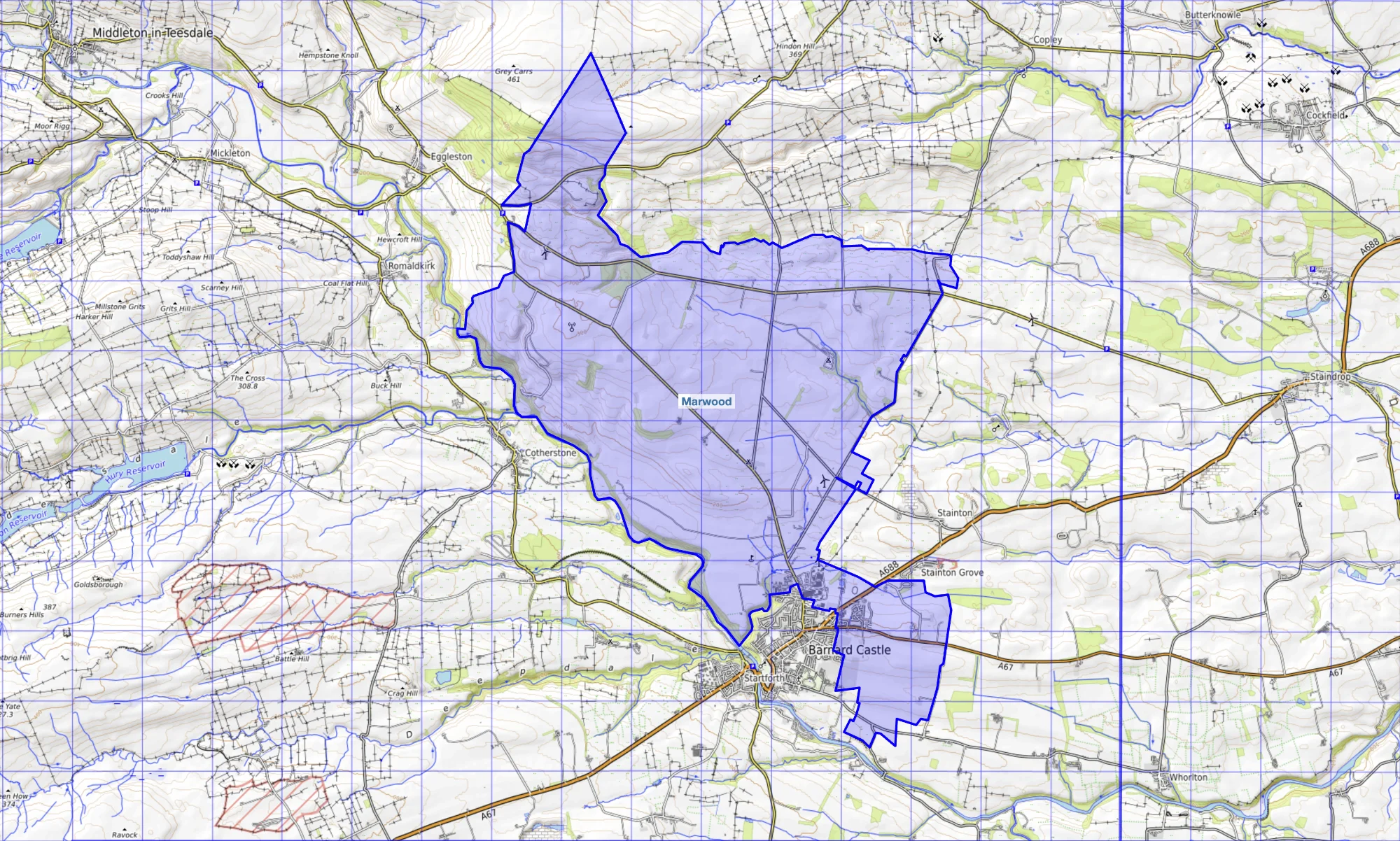
A modern map of the parish boundaries is shown below:
Teesdale Underfoot
Every scheduled monument in the Tees catchment, from Cauldron Snout to Piercebridge — 161 protected sites spanning roughly four and a half thousand years, plotted where they actually are. View map here.